

Meditation on Swami Muktananda’s Words
Siddha Yoga Satsang in Honor of Easter
by Eesha Sardesai
Concluding Thoughts
Since January of this year, 2026, I have been writing these “Meditations” on Gurumayi’s and Baba Muktananda’s teachings from Siddha Yoga satsang. And even before this, for the last several years, I have been writing about the Guru’s teachings in different contexts for the Siddha Yoga path website. To this day, however, I have not ceased to be amazed by just how much wisdom is packed into these teachings—how much there is to learn, and unearth, and understand. If anything, my sense of wonder and astonishment has only grown. The more time I spend with the Guru’s words, the more grateful I am. Gurumayi’s words, Baba’s words—they are a primer for life. They are my primer, for my life.
This set of contemplations—“Meditation on Swami Muktananda’s Words”—has focused on the passage from Play of Consciousness that Ben Williams read aloud during the Siddha Yoga satsang in honor of Easter. The satsang, held via live video stream on April 4, was titled “Breathe In the Spirit of Spring.” You may have noticed my recurring references to this theme.
When Gurumayi asked me to write about the passage from Play of Consciousness—explaining to me how crucial it is that we understand what Baba is teaching here about the value of the human body and human life—I was very honored. I was also excited for the challenge. The story that Baba tells in this passage is so clear, concise, and to the point. I was curious to see what insights I could share that would be new and useful for you—that would give you additional perspectives to consider, beyond what may already be evident on the page.
Five installments later, I hope I’ve achieved what I set out to do. What I can say with confidence is that Baba’s words open up innumerable avenues for contemplation—countless questions that we can ask of ourselves and others. The thoughts I’ve shared here really are just a drop in the proverbial bucket. To that end, I’ve been happy to hear from a number of you—and to read in your comments on the website—that you have been returning to this passage from Play of Consciousness, that you have been discussing your own ideas about this passage in addition to mine. I encourage you to keep doing so throughout Baba’s Month, even as our collective study on this topic concludes. In fact, you can now also listen to Ben’s wonderful reading of the passage on the Siddha Yoga path website.
I do want to share a cautionary note. While there is infinite wisdom to be found in the Guru’s words, it’s not a given that every thought that pops into our heads about these teachings will be a particularly helpful one. There is a difference between contemplation and endless rumination.
Contemplation leads us somewhere constructive—and on the Siddha Yoga path, that means closer to an understanding of our own (lowercase) self and (capital-S) Self. Rumination, on the other hand, is just a spinning of our wheels. Energy that’s not going anywhere. Of course, I’m not suggesting that we now rigidly monitor our thoughts, that we criticize what comes up for us or suppress these thoughts before they’ve even fully formed. But I am recommending that we be conscious about which thoughts we continue to give our attention to, in the interest of supporting our own sadhana and making the best use we can of our time.
In this vein, I have tried to be mindful that I am in fact contemplating—and then sharing with you, in these “Meditations,” as distilled and precise an articulation of that contemplation as possible. As anyone who knows me well will affirm, I have no shortage of thoughts, ideas, and opinions—about pretty much anything. And then there’s the specific topic we’re focusing on here: the body. It is a fraught topic to wade into, to say the least—not one we’re generally inclined to be objective about. We all have bodies and we all have thoughts about our bodies. I am not immune to that tendency.
But that is what makes Baba’s words in this passage so remarkable. Baba’s words prompt us to depersonalize the body, in a sense—to unfetter it from the mundane expectations we place on it, the fair and unfair assessments we make of it, the assorted vanities in which we enmesh it. Baba is encouraging us to adopt a more elevated perspective, to understand what the body truly is and leads us to.
A Body Is Divinity Expressed (ABIDE)
In my “Concluding Thoughts” for the previous two sets of “Meditations,” I shared with you the acronyms I developed to remember and support my study of Gurumayi’s teachings. As I explained then, it is because of Gurumayi that I’ve come to appreciate the utility of such mnemonic devices for learning and recall.
Since “Meditation on Swami Muktananda’s Words” has focused on one topic, and one passage from Play of Consciousness, I have endeavored to come up with a single acronym that is broadly representative of the ideas we’ve been exploring. That acronym is “A Body Is Divinity Expressed,” or “ABIDE.” We have learned from Baba and Gurumayi that God abides in this body. That this body is a unique expression of God. That the body is the means by which we come to know God. This is why the saint in Baba’s story is overcome with gratitude for his body, why he makes a point of thanking his body just before his time on this earth comes to a close.
Gurumayi has spoken on many occasions about how much Baba Muktananda loved the scriptures of India. So, in homage to that, I wanted to see what these scriptures have to say about the body. To be clear, they say a lot. And often, they say it through creative and beautiful metaphor. In the Bhagavad Gita, Lord Krishna speaks of the body as a field, the arena in which and by which one attains the knowledge of God.1 Meanwhile, in the Katha Upanishad, the body is described as a chariot, for which the mind serves as the reins, the intellect is the driver, and the horses that pull the chariot are the senses.2
It’s a striking image, the senses as horses. An especially relevant one, too, during this Year of the Horse. (We have already, as you might remember, spoken about “horsepower” in these “Meditations.”) Horses have tremendous energy and strength. They can travel to nearly any destination on land. It is up to the person riding the horse to choose what destination that will be, and to develop the skill and discipline required to stay the course until they reach that destination.
So it is with the senses. Gurumayi and Baba have taught that the senses are extremely powerful, and also neutral—that is to say, their energy is not committed to moving in any one direction. This combination of power and mutable direction is potent; we have within us this mass of energy just waiting to go somewhere. Our experience of life—and what we accomplish in this life—are reliant in large part on where it is that we direct this energy to go. Where we allow it to linger. Where we let it abide.
At the conclusion of each installment of “Meditation on Swami Muktananda’s Words,” I referred to one of the five senses and how we might make productive use of it. This was my attempt to remind you—and myself—that for all the external stimuli we encounter, and that might impel the energy of our senses outward, we can make a different choice. Our intellect is the driver; our mind is the reins. We have the ability and the agency to coax that same energy inward, to usher it toward the dwelling place of God within. Of course, one of the wondrous outcomes of doing this is that we begin to experience our outer world anew. We still participate in this world, we still enjoy it and appreciate it, but our well-being is no longer solely determined by its ups and downs. We stop being victims of circumstance.
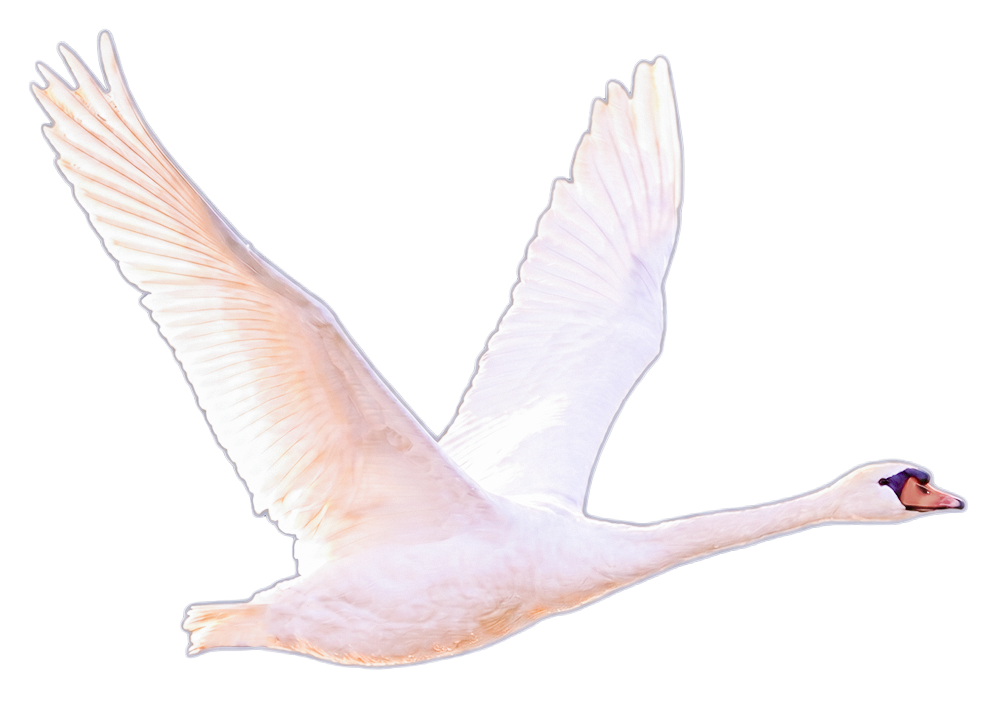
As I am already giving you a peek behind the curtain of what I was intending with these “Meditations,” there’s something else I want to share with you. You will have seen, I am sure, the swan imagery that’s been featured on these pages. Perhaps you noticed how the swan is gradually taking flight across each successive installment. I am delighted to share that some of the swan images in this progression are based on photos taken by you, the Siddha Yogis and new seekers in the sangham, and submitted to the Siddha Yoga path website.
I’d also like to explain why the swan is being featured. Gurumayi has spoken many times in satsang about how the designs on the Siddha Yoga path website carry specific meaning and intention. That is no different here.
In the Indian scriptures, the swan, or hamsa, is rich with symbolism. One of the many things it represents is the individual soul, which moves from one lifetime to the next until, eventually and through sadhana, it becomes liberated. The swan imagery in “Meditation on Swami Muktananda’s Words” is meant to evoke this progressive movement toward freedom—the individual’s attainment, through the body, of that which exists beyond the body.
And there’s another reason why the image of the swan is so perfect, so appropriate, for this particular set of contemplations. Baba was frequently referred to as “Swami Muktananda Paramahamsa.” In the Indian tradition, this appellation—paramahamsa, or “supreme swan”—is used in reference to enlightened beings, those who embody the freedom that the swan represents. So when I see the swan here—when I make a kind of flip-book in my mind of its movement, when I picture it taking flight—I think of Baba. I think of who he was and is for his devotees, and of the legacy he has left on the world.
Thank you once again for reading and listening to my contemplations on Swami Muktananda’s words. Thank you for sharing your responses to what I have written, your answers to the questions I have posed, and your own experiences and understandings of Baba’s teachings. I can think of few activities that I’d rather be doing—few activities that are more worth my while—than to sit somewhere quietly and contemplate the Guru’s words. But if I had to choose, it would be to contemplate the Guru’s words like this, with you, in our very own digital Sadhana Circle.
As I conclude this set of contemplations, I’d like to call up the words of one of the shanti mantras we recite on the Siddha Yoga path to invoke the Guru’s grace:
oṁ saha nāvavatu । saha nau bhunaktu ।
saha vīryaṁ karavāvahai ।
tejasvi nāvadhītam astu mā vidviṣāvahai ॥
oṁ śāntiḥ śāntiḥ śāntiḥ ॥
Om. May we, Guru and disciple,
be protected [through this study of knowledge].
May it sustain us both.
May we act with strength and energy.
May our knowledge be full of light.
May we never have enmity for one another.
Om. Peace, peace, peace.3
Sadgurunath Maharaj ki Jay!
- 1Shrimad Bhagavad Gita, 13.1.
2Katha Upanishad, 1.3.3–4.
3English translation © 2026 SYDA Foundation®.
Audio recording by Eesha Sardesai