In my introduction to August on the Siddha Yoga path, I shared that Gurumayi has given the practices of meditation and mantra japa as a focus for this month. We can, therefore, draw connections between this focus and each of the Siddha Yoga holidays in August.
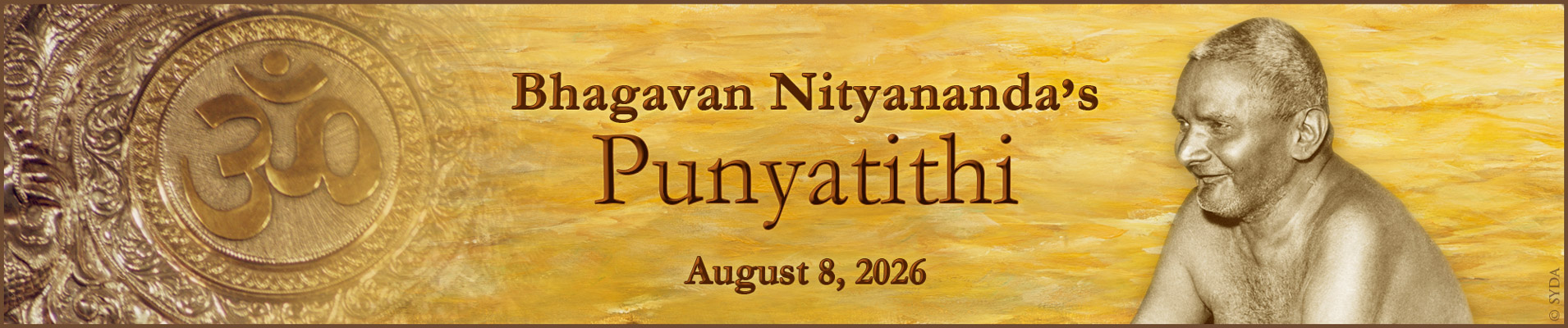
The first of these holidays is Bhagavan Nityananda’s Punyatithi. By the solar calendar, Bade Baba’s Punyatithi takes place on August 8, while the lunar punyatithi is the day right after, on August 9. As I explained in the introduction, Bade Baba’s Punyatithi is the anniversary of his passing, the day in 1961 when he left his physical form and merged with supreme Consciousness. In the scriptural text Viveka-chudamani, the great sage Adi Shankaracharya gives an analogy which can help us to better understand what it means when a realized being passes. Adi Shankaracharya says:
When an earthen pot is broken, the space within it becomes one with the limitless space outside. In the same way, when the outer appearance dissolves, the knower of Brahman becomes Brahman itself.1
Bade Baba is, was, and will forever be one with the supreme Consciousness that pervades our world. The body may be transient; the guru-shakti is not. This is why Bade Baba’s presence, and his blessings, remain so vibrantly with us sixty-five years later. (To learn more about why, in the Indian tradition and on the Siddha Yoga path, we observe a great being’s punyatithi, I encourage you to read the exposition on this topic that is on the website.)
When I think of Bade Baba, especially on the occasion of his punyatithi, my mind often goes to Gurumayi’s beautiful poem A Temple Without Form. In this poem, Gurumayi speaks of how the entire universe is Bade Baba’s Temple—and that we can, for example, receive Bade Baba’s darshanin the beauty of nature. To do this, Gurumayi explains, “is to meditate with the eyes open.”
I remember the awe I experienced when I first read this poem by Gurumayi. It expanded my understanding of who Bade Baba is and was, as well as my perception of what Siddha Yoga meditation could be. It is a practice for which we need not remove ourselves from our world. We can meditate in and amidst that world; in fact, our meditation practice can be inspired by it. In her poem, Gurumayi gives many, many examples of things in nature—and even things that are human-made—through which we can connect with Bade Baba’s presence. In all of these things, we can perceive an underlying Consciousness, the very energy we seek out and endeavor to tap into when meditating.
Of course, it might take some effort to see the world in this way. To hear the silence in sound, to recognize the calm that undergirds activity. For this reason, we are incredibly fortunate that on the Siddha Yoga path, the Guru has given us a direct means by which to access this awareness. We have been given the mantra Om Namah Shivaya.
Bade Baba imparted this mantra to the seekers who came before him. It was famously through Bade Baba’s imparting of the mantra that Baba Muktananda received shaktipat initiation. Bade Baba taught that among the many fruits of mantra repetition was the experience of oneness—that is to say, oneness with God, oneness with the Guru, oneness between the worlds outside and within one’s person.
What I love about mantra japa is that it is a practice we can do practically anywhere. And it is often when I take the mantra with me, so to speak—when I remember it, and repeat it, in the course of my day-to-day life—that I have glimpses of this oneness that Bade Baba speaks of. I am thinking, for instance, of how Gurumayi has encouraged us to take japa walks. She has even invited us to join her on a japa walk via the Siddha Yoga path website! I find that as I walk and repeat the mantra silently to myself, eventually it starts to feel as though the mantra is emanating from everywhere and from nowhere. It is in the trees as their leaves rustle in the wind. It is in the sunlight dancing on the surface of water. It is in the sound my footsteps make and in the beating of my heart. It reveals itself in all the countless forms around me.
It’s freeing—is it not?—that our spiritual practice is not contingent upon our environment always being perfectly still and silent. The Indian scriptures tell us that the world itself arose from a propulsion of sound, from the primordial sound AUM. Recently, I learned from Gurumayi that even flowers emit sound when they bloom. The frequency of this sound is beyond what we can hear with our ears alone, but still, it is there. On some level, it resounds. This is wonderful, inspiring knowledge to hold in mind on the occasion of Bhagavan Nityananda’s Punyatithi, as we look about our world and remember that all of this is Bade Baba’s abode, his Temple, the formless given myriad forms.
When I read that our sadhana does not depend on whether there is stillness outside, it filled me with deep love and solace. I am facing significant challenges right now. I am doing more and more mantra japa, inspired by Gurumayi’s guidance for this month.
Yesterday, amidst challenging thoughts and emotions, I repeated the mantra. Then I decided to tell Bade Baba about my situation. As I went on absorbing the mantra along with my breath, I sat in meditation with the awareness that the knower, Bade Baba within me, already knows everything. I found myself becoming silent and still. I felt the disturbing thoughts being replaced with the stillness of Bade Baba’s grace and divine blessings.
Om Namah Shivaya! I experience the powerful mantra continuing within me even now.
Dombivli, India
I have so much gratitude for Shri Gurumayi for her bestowing shaktipat initiation upon me on Bade Baba’s Punyatithi in 1992. I have been repeating the mantra Om Namah Shivaya ever since.
Years ago, I learned from Gurumayi to repeat the mantra eleven times before stepping out on my right foot at the threshold of my home. I have been engaging in this practice ever since.
Doing this gives me immediate access to the center of power within me. No matter how tired my body is, no matter my mental mood, the weather, or the outer circumstances, I am immediately bathed in Gurumayi’s scintillating love. And the mantra continues silently, supporting me throughout the day.
Nevada, United States
Recently, I had the great good fortune to visit the Siddha Yoga Ashram in Oakland, where I participated in the Ashram Daily Schedule. Through seva and the other practices, I experienced a deepening connection with the Guru and the grace that guides my sadhana.
One day, while seated in Bhagavan Nityananda’s Temple, a spontaneous meditation arose: in my inner vision, I saw myself placing Bade Baba’s name at the crown of my head and then moving it through my entire body. This has since continued in my daily meditations and has brought me increasing stillness, a connection to grace, and a growing recognition of the Guru within.
Awareness, accountability, and acceptance are becoming living practices—teaching me how to meet my thoughts, feelings, and beliefs with greater presence. Through remembrance of the Guru and repetition of the mantra Om Namah Shivaya, the stories my mind creates begin to dissolve into the presence of grace, returning me to my Self and the Truth within.
Squamish, Canada
I was first introduced to the practice of mantra japa while participating in the Pilgrimage to the Heart Retreat in 2015. Since then, whenever I take my morning walks with my dog, I take the time to look around and enjoy the trees, the flowers, the sky, and the breeze while reciting the mantra.
There is a calm that comes over me as the silent sound of the mantra reverberates within. It brings me back to my Self and centers me for the day.
Missouri, United States
Today, on Bade Baba’s Lunar Punyatithi, I decided to go for a “japa walk” through the Siddha Yoga path website.
As I repeated the mantra, I viewed the beautiful images in the Nature Gallery, which included images of the grounds in Shree Muktananda Ashram and the Bhagavan Nityananda Temple with the magnificent murti of Bade Baba himself in its center. I then offered dakshina via the Siddha Yoga path website.
This virtual japa walk was such a beautiful and powerful practice for me! All the images felt alive with the profound stillness I associate with Bade Baba—a stillness that has completely enveloped me.
Havant, United Kingdom
Reading Eesha’s essay where she speaks of the mantra and “hearing the silence in sound” reminded me of a dream I had of Baba Muktananda, whom I never met in his physical form.
There were thousands of people streaming into the Shakti Mandap—the beautiful glass-enclosed building on the grounds of Shree Muktananda Ashram—where many chants have taken place.
From where I was standing, I could see that it was Baba himself who was holding open the door through which all the people were streaming in, though no one else appeared to see him.
Baba was smiling beatifically.
Despite the crowds, the only sound I could hear in the dream was the sound of the japa mala turning in Baba’s hands. It was a strong “whooshing” sound, like a lasso in the wind. I experienced Baba’s complete immersion in the practice of mantra japa, and I understood that this immersion was the underlying reality of what I was witnessing in the dream.
New York, United States
For a long time, I associated mantra japa with walking in nature, where silence and beauty naturally supported my practice.
More recently, I have begun repeating Om Namah Shivaya as I walk through the vibrant streets of the city where I live—among crowds of people, traffic, stoplights, and car horns. As I repeat the mantra, I experience a quiet steadiness amid the sounds and rhythms of the cityscape.
Reading Eesha’s words about “hearing the silence in sound” has given me a new understanding of this experience. I can recognize the mantra’s vibration within me while remaining fully present to everything around me. On Bade Baba’s Punyatithi, I feel deeply grateful for the opportunity to renew this awareness: wherever I walk, I am walking within “a Temple without form.”
Buenos Aires, Argentina
I was so happy to enjoy the ”Autumn Japa Walk” around Lake Nityananda that Eesha drew our attention to! I have walked around that lake more times than I can count, always enjoying the beauty of nature. I also love the fall season and its vibrant colors, which make me feel alive.
Adding the mantra to my walks will certainly calm my mind and allow me to experience God in every particle of this universe! I am grateful for this reminder.
California, United States
For Bade Baba’s Punyatithi, I had planned my day carefully and wanted to set aside plenty of time for spiritual practices in honor of Bade Baba. But things turned out differently. I woke up feeling rather unwell. So I spent the day very quietly at home, looking after myself, enjoying the silence, and thinking of Bade Baba.
I realized just how busy I always am and that my daily schedule leaves me little time simply to be and to do nothing.
Thanks to the very calm and serene rhythm of the day, I sank into a deep inner peace, and now, in the evening, I feel as though I’ve been “meditating with the eyes open” all day and have spent much precious time in Bade Baba’s presence.