


A Time of Protection
Raksha Bandhan
by Eesha Sardesai
Throughout this month on the Siddha Yoga path, we have been applying ourselves to the focus practices that Gurumayi has given to us of meditation and mantra japa. We have been working with them specifically in relation to the holidays in August—first, Bhagavan Nityananda’s Punyatithi, then Baba Muktananda’s Divya Diksha, and now, Raksha Bandhan.
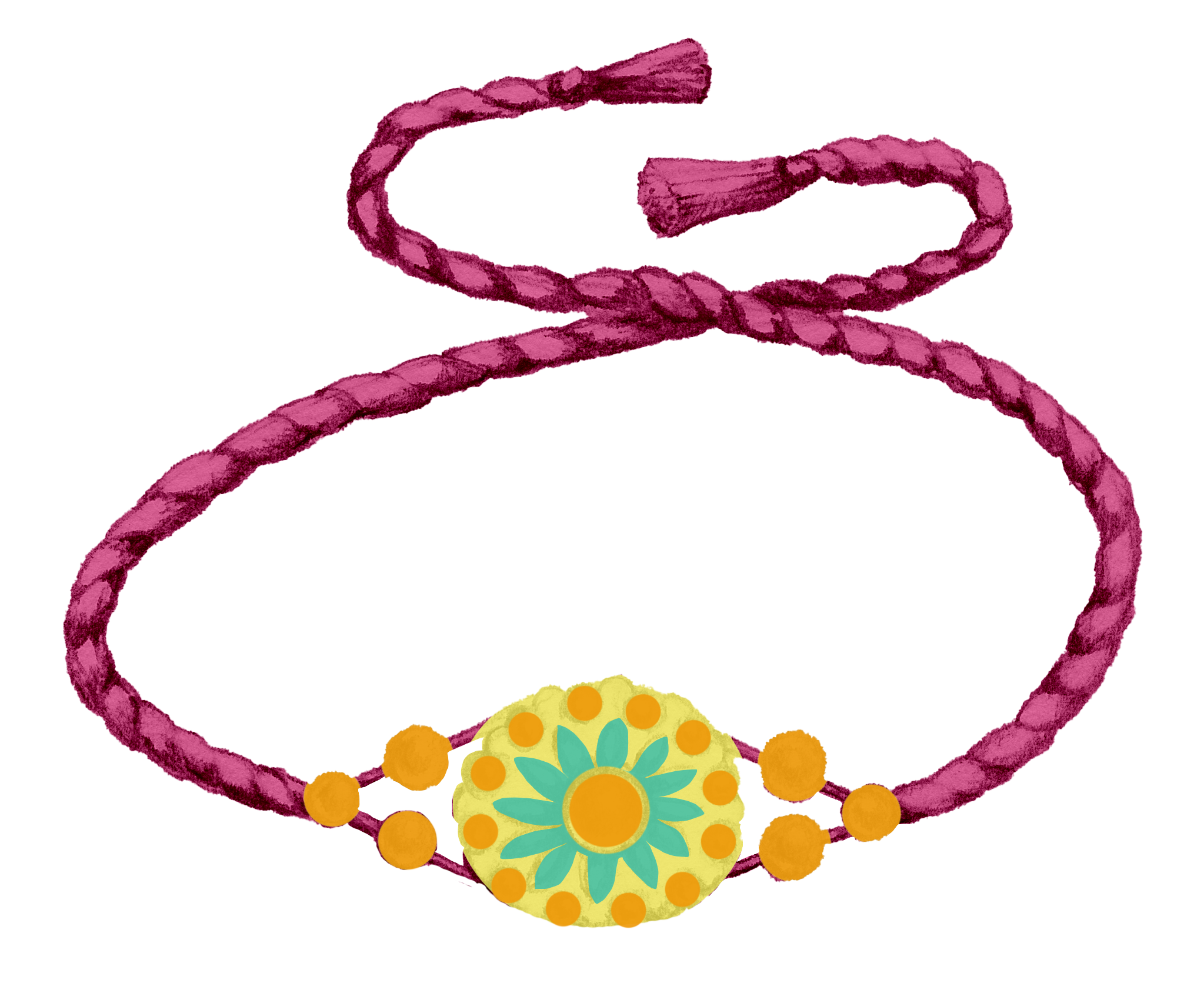
Raksha Bandhan takes place on the full moon, or “Rakhi Purnima,” which is August 27 this year. As I wrote earlier this month, Raksha Bandhan is a holiday with deep roots in the Indian cultural and scriptural tradition, with various accounts recorded of gods and goddesses, kings and queens, and other individuals and groups of people exchanging rakhis, or bracelets made of thread. In modern times, the popular custom in India is for sisters to tie rakhis on their brothers’ wrists on Raksha Bandhan.
For millennia, then, the rakhi has served as a potent symbol, signifying respect between people and their commitment to protecting one another. On the Siddha Yoga path, the symbolism of the rakhi is especially profound, as it represents the bond of love and protection between Guru and disciple. Now, what specifically we are wishing to protect is worthy of consideration—and precise articulation. It is the light that the Guru has awakened within us, the awareness of the divinity in ourselves, which we can also find reflected in others and all throughout the surrounding world. It is that visceral sense of connection to the love in our hearts, which we strengthen through our Siddha Yoga practice.
The English word protection is derived from the Old French word proteccion (meaning “protection, shield”), which in turn comes from the Late Latin protectionem, meaning “a covering over.” I find this to be an instructive lens through which to view our practice of meditation and its outcomes. In my own experience, I have seen that every time we practice Siddha Yoga meditation, we are fortifying our awareness of the Self, of the flame within. In a sense, we are safeguarding that awareness—shielding it from, and gradually making it impervious to, any of the internal and external forces that could cause us to forget it. The waves of samsara may threaten to buffet us, but we remain anchored in who we are, in what the Guru has endowed us with.
This brings me back to the rakhi, that seemingly simple bracelet of thread. Since forgetfulness is a very real danger that we must guard against, having a physical, tangible reminder of protection can be both useful and reassuring. In fact, in India, there is a rich history of protective threads. In certain religious ceremonies, priests or elders tie maulis, bracelets made of interwoven yellow and red threads, on devotees’ wrists to ward off evil forces. Similarly, black threads are often tied on the wrists of children—again, as a kind of protective amulet, and to repel buri nazar, or the “evil eye.”
On the Siddha Yoga path, Gurumayi has spoken about smaranikas, talismans that support remembrance. The rakhi that we tie in acknowledgment of our bond with the Guru can be one such smaranika. Another essential smaranika of the Siddha Yoga path is the japa mala, which we use to practice mantra japa. As we move each bead on the japa mala, we repeat the mantra to ourselves, affirming again and again the presence of the supreme Self in our hearts. It is powerful to carry such a physical object on our person—the mala in the form of a bracelet or even a ring. It serves as a constant reminder for us of our practice of japa, and of what we gain and what we protect by doing japa.
It is also a reminder of the protection we wish to extend. My experience has been that the protection we invoke when practicing mantra japa and meditation is not limited to ourselves. It ripples outward, encompassing whomever we encounter, whatever we interact with.
Audio recording by Eesha Sardesai